Heat in the material
Electrical current passes directly through the carbon bed, reducing the need to heat a large furnace mass.
Electrothermal carbon processing · Germany
Felderion is developing a controlled electrothermal process for electrically conductive carbon materials, in which the material's own electrical response determines when treatment is complete. The first application is the reconditioning of battery anode graphite recovered from hydrometallurgical recycling.
Patent pending · DPMA priority filing · July 2026
The problem
Recovered and residual carbon feedstocks vary between lots. Residual chemistry, surface films, moisture, particle contact, packing state and electrical conductivity all shift from batch to batch.
Conventional thermal processing answers this variability with a fixed recipe: a set temperature and a set time. Run that recipe on two different lots and one can be over-treated while the other remains under-treated.
Recovered carbon is not necessarily unusable. The process simply cannot yet guarantee when the right material state has been reached.
The process
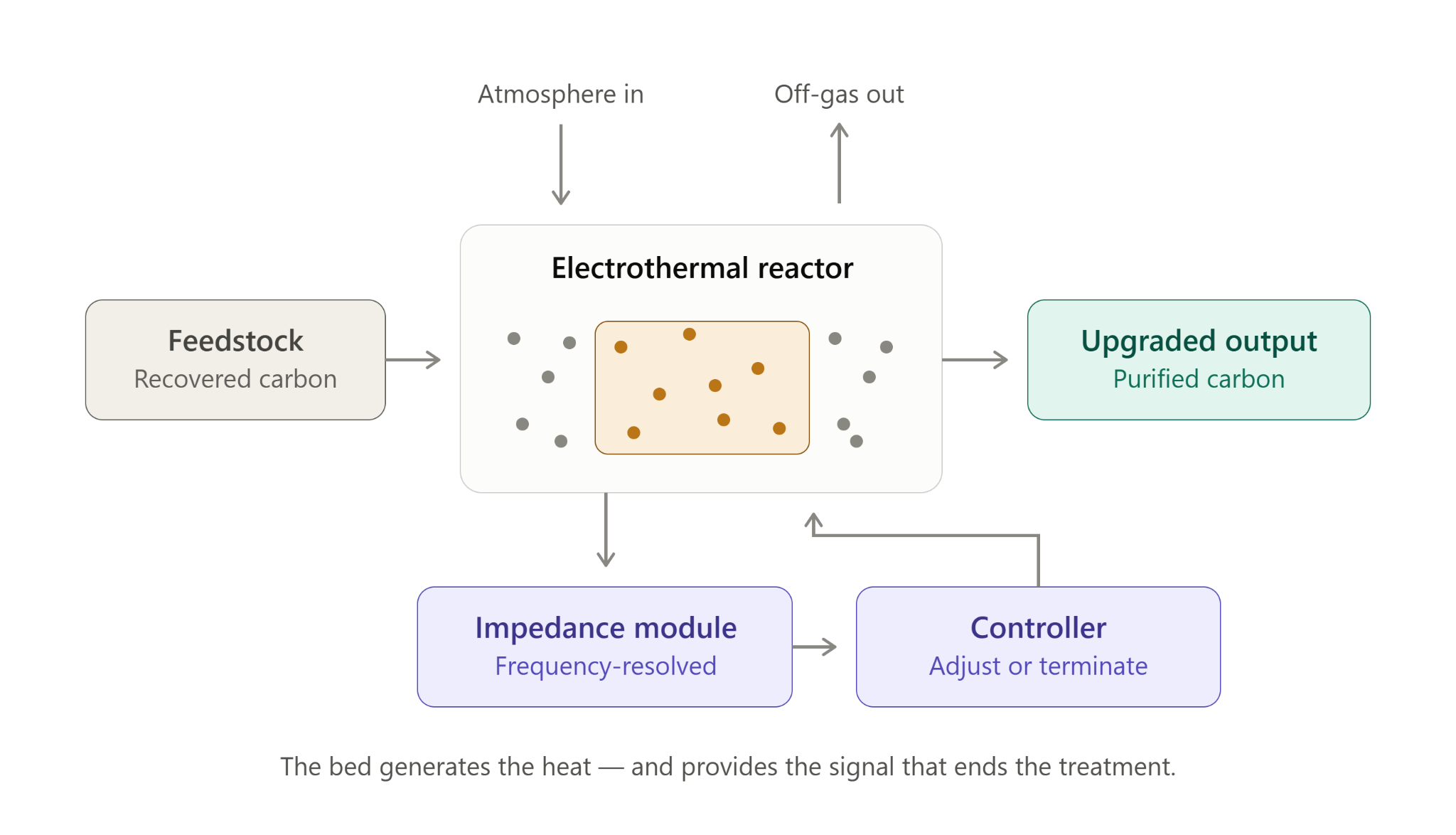
Felderion passes current directly through an unconsolidated bed of conductive carbon. The bed generates its own Joule heat. Its electrical response is measured during treatment and used to determine when the process should adjust or stop.
Electrical current passes directly through the carbon bed, reducing the need to heat a large furnace mass.
Frequency-resolved electrical behaviour tracks the evolving state of the material during treatment.
The controller uses the material-state signal to adjust or terminate the process at the defined endpoint.
First application
Hydrometallurgical recycling is engineered primarily to recover valuable metals. Graphite can leave the same process as a low-value residue, even though it remains a strategic raw material.
Felderion's working thesis is that the graphite host can often be returned toward a useful material state through purification and surface reconditioning rather than remanufacture from virgin feedstock.
The platform
The same coupled architecture can be evaluated for carbon feedstocks that form an electrically conductive particulate bed. Graphite regeneration is where the process is being proven first. Further property-defined applications will follow only as data is generated.
01
Purified, reconditioned or graphitised carbon discharged as a particulate product.
02
A future route in which treated carbon is consolidated at temperature without a separate cooling, milling and reheating cycle.
Evidence before claims
Quantified energy, carbon and performance claims will be published only after experimental validation against a clearly defined reference process.
kWh per kilogram
kg CO₂e per kilogram
Application-relevant specification
Recovered usable material
Lot-to-lot consistency
Development roadmap
Completed
Current position · July 2026
Next
Planned
Planned
Future
About
Felderion was founded by Dr.-Ing. Tarini Prasad Mishra, a materials scientist specialising in electric-field-assisted processing and advanced manufacturing.
He completed his doctorate summa cum laude at Forschungszentrum Jülich and has worked across scientific research, battery and materials strategy, recycling and industrial business development.
Felderion is an independent venture and is not affiliated with, endorsed by, or acting on behalf of any current or former employer or institution.
08 — Work with us